


GLP-3 | Retatrutide

€100.00
Technical Specifications
| Specification | Detail |
|---|---|
| Product Name | Retatrutide (LY3437943) – R&D Only |
| Common Name | GLP-3 / Triple-G |
| CAS Number | 2381089-83-2 |
| Molecular Formula | C₂₂₁H₃₄₂N₄₆O₆₈ |
| Molecular Weight | 4731.33 Da |
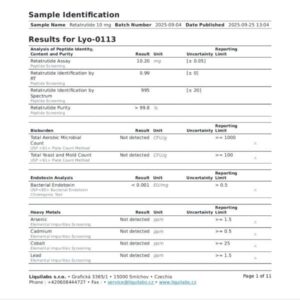
| Purity | ≥99% (HPLC verified) |
| Appearance | White to off-white lyophilized powder |
| Solubility | Soluble in water, PBS, and appropriate buffers |
| Target Receptors | GLP-1R, GIPR, GCGR |
| Mechanism | Triple hormone receptor agonist |
| Half-Life | Approximately 6 days |
| Key Research Applications | Obesity, T2DM, osteoarthritis, OSA, MASLD, cardiovascular research |
| Storage (Powder) | -20°C; protect from light and moisture |
| Storage (Reconstituted) | 2-8°C (short-term); -20°C (long-term, aliquot) |
| Shipping | Ambient temperature with protective packaging |
| Intended Use | Research and laboratory use only |
| Documentation | Certificate of Analysis provided with each batch |
Premium Retatrutide (LY3437943) for Sale | ≥99% Purity | 48-Hour Delivery Across EU & UK
Understanding GLP-3 and Retatrutide: The Next Generation of Metabolic Research Peptides
https://eupeptidelap.co.uk/ is proud to present Retatrutide, a premium research-grade triple agonist peptide often referred to in scientific discourse as a “GLP-3” class compound due to its unprecedented triple receptor targeting mechanism. As a trusted peptide vendor uk and leading EU peptide supplier, we provide researchers across Europe with Retatrutide for sale that delivers exceptional purity, consistency, and documented quality for advanced metabolic studies .
Retatrutide (LY3437943) represents a revolutionary advancement in metabolic research as the first-in-class triple agonist peptide targeting three key hormone receptors simultaneously: the glucagon-like peptide-1 (GLP-1) receptor, the glucose-dependent insulinotropic polypeptide (GIP) receptor, and the glucagon (GCG) receptor . While not an official nomenclature, the term “GLP-3” has emerged in scientific and media discourse to describe this novel class of triple agonists that extend beyond the dual-action mechanisms of existing therapies .
The nickname “GLP-3” or “Triple-G” reflects the drug’s unique ability to harness the complementary actions of three distinct metabolic hormones, producing unprecedented effects that surpass even the most advanced dual agonists currently available . Unlike traditional GLP-1 receptor agonists that target a single pathway, or dual agonists that target two, retatrutide’s triple mechanism represents a paradigm shift in understanding how multiple hormonal signals can be coordinated to achieve superior metabolic outcomes .
The molecular formula of Retatrutide is C₂₂₁H₃₄₂N₄₆O₆₈, with a molecular weight of 4731.33 Da . Its sophisticated structure includes three non-coding amino acid residues at positions 2, 13, and 20—Aib2 provides stability from dipeptidyl peptidase-4 (DPP4) cleavage, Aib20 ensures optimal GIP activity and pharmacokinetic profile, while αMeL13 promotes balanced receptor activation . This engineered stability, combined with a C20 fatty diacid moiety that enables albumin binding, results in a long half-life of approximately 6 days, supporting once-weekly administration in clinical settings .
For researchers seeking to buy peptide online EU for investigations into metabolic disorders, obesity pharmacotherapy, type 2 diabetes, or complications of obesity such as osteoarthritis and sleep apnea, eupeptidelap.co.uk offers this premium research compound with comprehensive documentation, including Certificates of Analysis and batch-specific purity data . Whether your laboratory is based in London, Berlin, Paris, or anywhere in the European Union, our guaranteed 48 hour delivery peptide service ensures your research continues without interruption.
The Scientific Foundation of GLP-3 / Retatrutide Research
The Evolution from Single to Triple Agonism
The development of retatrutide represents the culmination of decades of research into incretin hormones and their role in metabolic regulation . First-generation therapies (GLP-1 receptor agonists like semaglutide) targeted a single hormone pathway, achieving approximately 15% average weight loss at 68 weeks . Second-generation dual agonists (GIP/GLP-1 agonists like tirzepatide) improved outcomes to approximately 21-22% weight loss .
Retatrutide, as the first triple agonist, has demonstrated the most robust results yet, with Phase 2 trials showing 24.2% weight loss at 48 weeks and Phase 3 TRIUMPH-4 trial results demonstrating 28.7% average weight loss at 68 weeks—approaching the efficacy of bariatric metabolic surgery . This progressive improvement illustrates the power of multi-receptor targeting in metabolic research.
Mechanism of Action: Triple Receptor Activation
Retatrutide exerts its effects through simultaneous activation of three key receptors, creating synergistic actions that exceed what any single pathway could achieve alone :
GLP-1 Receptor Activation: Glucagon-like peptide-1 is an incretin hormone that helps regulate appetite and signals satiety. It stimulates insulin release, lowering blood sugar, and acts on the central nervous system to reduce appetite while slowing gastric emptying .
GIP Receptor Activation: Glucose-dependent insulinotropic polypeptide is another incretin hormone released during eating. Like GLP-1, it acts as a satiety signal and increases insulin production, while also helping regulate fat metabolism and blood sugar. Activating GIP receptors is thought to enhance the effects of GLP-1 when these two actions are combined .
Glucagon Receptor Activation: The addition of glucagon agonism is what truly distinguishes retatrutide from other metabolic peptides . While glucagon alone would raise blood sugar—potentially counteracting weight loss efforts—when activated alongside GLP-1 and GIP receptors, it increases overall energy expenditure and fat burning without excessively raising blood glucose . This novel combined mechanism means retatrutide is the first metabolic peptide to target three pathways, effectively adding an “efficient combustion engine” to the “fuel limiter” effects of GLP-1 and GIP .
The “GLP-3” Nomenclature Explained
The term “GLP-3” has gained traction in both scientific and popular media to describe this new class of triple agonists . Major news outlets, including FOX NEWS, have featured discussions of “GLP-3s” as the next generation of metabolic therapies, with experts noting that the addition of glucagon agonism represents a fundamental advancement in how these drugs work .
According to media reports, if first-generation GLP-1 drugs function like installing a “fuel limiter” on the body’s energy intake, then “GLP-3” drugs like retatrutide not only limit fuel intake but also install a “high-efficiency combustion engine” (GCG activation) that actively burns excess fat . This conceptual framework helps explain the superior efficacy observed in clinical trials.
Pharmacokinetic Profile
Retatrutide has a relatively long half-life of approximately 6 days, which supports its administration as a once-weekly subcutaneous injection . This extended half-life is beneficial for maintaining steady plasma levels of the peptide, contributing to its sustained effectiveness in reducing body weight and improving metabolic parameters . Upon administration, retatrutide is absorbed and distributed efficiently throughout the body, reaching therapeutic concentrations with a predictable pharmacokinetic profile .
Key Research Applications
Obesity and Weight Loss Research
Retatrutide is extensively used in studies investigating body weight regulation, adipose tissue biology, and energy homeostasis. Clinical trials have demonstrated unprecedented weight loss results that set a new high bar for obesity pharmacotherapy research .
Phase 2 Clinical Trial Results: The landmark Phase 2 randomized, double-blind, placebo-controlled trial published in the New England Journal of Medicine demonstrated that participants receiving 12 mg weekly achieved a mean weight reduction of 24.2% of initial body weight at 48 weeks .
Phase 3 TRIUMPH-4 Trial Results: Results announced in late 2025 demonstrated even more impressive outcomes, with participants taking retatrutide 12mg losing an average of 28.7% of their body weight at 68 weeks—approximately 32.3 kg or 71.2 pounds . Among those taking the 12mg dose, 58.6% achieved ≥25% weight loss, 39.4% achieved ≥30% weight loss, and 23.7% achieved ≥35% weight loss .
These results approach the efficacy of bariatric metabolic surgery, leading some experts to describe retatrutide’s effects as “approaching the level of metabolic surgery” .
Type 2 Diabetes Research
Retatrutide has demonstrated exceptional efficacy in glycemic control research . The triple agonist mechanism provides robust improvements in glucose homeostasis through multiple pathways:
-
Enhanced insulin secretion through GLP-1 and GIP receptor activation
-
Improved insulin sensitivity
-
Reduced glucagon secretion when blood glucose is elevated
-
Beneficial effects on body composition that indirectly improve glycemic control
A systematic review of clinical trials confirmed that retatrutide leads to significant improvements in glycemic control outcomes, marking it as a promising therapeutic for type 2 diabetes mellitus .
Knee Osteoarthritis Research
The TRIUMPH-4 trial specifically evaluated retatrutide in 445 adults with obesity or overweight and knee osteoarthritis . Results showed remarkable improvements:
-
Pain scores improved substantially, with retatrutide reducing Western Ontario and McMaster Universities Osteoarthritis Index (WOMAC) pain scores by up to 4.5 points (approximately 75.8%), compared with a 2.4-point (40.3%) reduction with placebo .
-
In a post-hoc analysis, approximately 1 in 8 (12.5%) retatrutide-treated participants reported being completely free of knee pain at week 68, compared with just over 4% of placebo recipients .
-
Measures of physical function improved, with reductions in the WOMAC function subscale exceeding 70% for both retatrutide doses .
Researchers note that these improvements likely stem from both weight reduction (reducing mechanical stress on joints) and the drug’s anti-inflammatory effects, lowering systemic inflammation markers .
Obstructive Sleep Apnea Research
The TRIUMPH clinical development program includes dedicated evaluation of retatrutide for obstructive sleep apnea (OSA), a common complication of obesity . The TRIUMPH-1 and TRIUMPH-2 trials include OSA-specific endpoints, measuring change in Apnea-Hypopnea Index (AHI) as a primary outcome .
Given that substantial weight reduction is often required to meaningfully improve OSA, retatrutide’s unprecedented efficacy positions it as a particularly promising candidate for OSA research .
Cardiovascular Risk Factor Research
Retatrutide has demonstrated significant improvements in multiple cardiovascular risk markers :
-
Blood Pressure Reduction: At the highest dose, systolic blood pressure decreased by 14.0 mmHg .
-
Lipid Improvements: Retatrutide lowered non-HDL cholesterol and triglycerides .
-
Inflammation Reduction: The drug reduced high-sensitivity C-reactive protein (hsCRP), a sensitive marker of cardiovascular risk .
Metabolic Dysfunction-Associated Steatotic Liver Disease (MASLD) Research
Retatrutide shows promise in addressing metabolic dysfunction-associated steatotic liver disease (MASLD), formerly known as non-alcoholic fatty liver disease . The combination of weight reduction, improved insulin sensitivity, and direct effects on hepatic fat metabolism through glucagon receptor agonism makes it particularly relevant for liver disease research .
Quality Assurance: Setting the Standard for Research Compounds
Manufacturing Excellence
eupeptidelap.co.uk sources Retatrutide from certified GMP facilities with rigorous quality control protocols:
-
HPLC Purity Analysis: ≥99% purity verified by high-performance liquid chromatography
-
Mass Spectrometry Verification: Molecular weight confirmation via LC-HRMS
-
Batch-Specific Certificates of Analysis: Complete documentation for each production run
-
Third-Party Lab Testing: Independent verification of purity and potency
-
Regulatory Compliance: Research Use Only (RUO) labeling with proper documentation
Chemical and Product Specifications
| Specification | Detail |
|---|---|
| Product Name | Retatrutide (LY3437943) – R&D Only |
| CAS Number | 2381089-83-2 |
| Molecular Formula | C₂₂₁H₃₄₂N₄₆O₆₈ |
| Molecular Weight | 4731.33 Da |
| Amino Acid Length | 39 amino acids |
| Purity | ≥99% (HPLC verified) |
| Appearance | White to off-white lyophilized powder |
| Form | Lyophilized powder |
| Solubility | Soluble in water, PBS, and appropriate buffers |
| Mechanism | Triple GLP-1/GIP/Glucagon receptor agonist |
| Half-Life | Approximately 6 days |
| Key Research Areas | Obesity, type 2 diabetes, osteoarthritis, sleep apnea, MASLD, cardiovascular risk |
| Storage (Powder) | -20°C; protect from light and moisture |
| Storage (Reconstituted) | 2-8°C for short-term; aliquot and freeze at -20°C for longer storage |
| Shipping | Ambient temperature with protective packaging |
| Intended Use | Research and laboratory use only |
| Documentation | Certificate of Analysis provided with each batch |
Stability and Handling Guidelines
Lyophilized Powder Storage: Retatrutide powder should be stored at -20°C in a dry, dark environment, protected from light and moisture. Use manual-defrost freezers and store vials in the back (not doors) to avoid temperature fluctuations.
Reconstitution Protocol:
-
Allow vial and solvent to reach ambient temperature before opening to prevent condensation
-
Reconstitute using sterile water, PBS, or appropriate buffer according to research protocol
-
Gently swirl until powder is completely dissolved—do not shake vigorously
-
Use fresh sterile needles for each vial access
-
Clean rubber stoppers with alcohol swabs before each puncture
Reconstituted Solution Storage: Once reconstituted, retatrutide solutions should be stored at 2-8°C for short-term use. For longer-term storage, aliquot into single-use portions and freeze at -20°C. Avoid repeated freeze-thaw cycles as this can degrade the peptide.
Protection from Light and Moisture:
-
Store in amber vials or protect from light
-
Keep vials tightly sealed when not in use
-
Allow frozen vials to reach room temperature before opening to prevent condensation.
Key Benefits
-
Premium Quality Manufacturing: GMP-certified production, ≥99% HPLC-verified purity
-
First-in-Class Triple Agonist: Simultaneous GLP-1, GIP, and glucagon receptor activation for synergistic research applications
-
Unprecedented Weight Loss Research: Enables investigation of 24-29% body weight reduction in obesity models
-
Superior Efficacy: Phase 3 results demonstrate 28.7% average weight loss at 68 weeks—approaching metabolic surgery outcomes
-
Knee Osteoarthritis Research: Reduces WOMAC pain scores by up to 75.8% with 1 in 8 participants achieving complete pain resolution
-
Sleep Apnea Research: Dedicated OSA endpoints in TRIUMPH program for comprehensive investigation
-
Cardiovascular Risk Research: Reduces systolic blood pressure, non-HDL cholesterol, triglycerides, and hsCRP
-
MASLD/NAFLD Research: Potential applications in metabolic dysfunction-associated steatotic liver disease
-
Type 2 Diabetes Research: Significant improvements in glycemic control outcomes
-
Energy Expenditure Studies: Glucagon agonism increases metabolic rate through enhanced fat burning
-
Appetite Regulation Research: Triple mechanism targeting satiety and reward pathways
-
Inflammation Research: Reduces systemic inflammation markers independent of weight loss
-
Extended Half-Life: Engineered stability with C20 diacid for albumin binding and prolonged duration
-
DPP-4 Resistant: Aib2 modification provides enzymatic stability
-
Comprehensive Documentation: Certificates of Analysis with batch-specific purity data
-
48-Hour EU & UK Delivery: Rapid shipping to research facilities across Europe
-
Batch Consistency: Rigorous quality control ensures lot-to-lot reproducibility
-
EU Sourced: Available from within the European Union
Frequently Asked Questions
Q: What is GLP-3 and how does it relate to Retatrutide?
A: “GLP-3” is an informal term that has emerged in scientific and popular media to describe the new class of triple agonist peptides like retatrutide that target GLP-1, GIP, and glucagon receptors simultaneously . While not an official pharmacological classification, the term captures the evolutionary progression from single-action GLP-1 drugs to dual-action GIP/GLP-1 agonists to this new triple-action mechanism . Retatrutide is the first-in-class triple agonist in this category.
Q: Is Retatrutide approved for human use?
A: No. Retatrutide from eupeptidelap.co.uk is strictly for research and laboratory use only. It is not for human or animal consumption, and must not be used for therapeutic, diagnostic, or clinical applications. While retatrutide is currently in Phase 3 clinical trials (expected to complete in 2026) and may receive regulatory approval in 2027, research-grade material is intended for investigational purposes only . Researchers must handle this compound in accordance with institutional safety guidelines and local regulations.
Q: What is the legal status of Retatrutide for research in the UK?
A: The sale of unlicensed peptides like retatrutide under “research use only” labeling is permissible under strict conditions for legitimate research purposes. Proper documentation including Certificates of Analysis, Safety Data Sheets, and explicit RUO labeling is mandatory. Researchers should note that unlicensed, illegal versions of retatrutide have reportedly already been sold online, making it essential to source from reputable suppliers with proper documentation .
Q: What purity level can I expect when I buy Retatrutide from eupeptidelap.co.uk?
A: All Retatrutide from eupeptidelap.co.uk is tested to ≥99% purity by HPLC. Each batch is individually analyzed, and Certificates of Analysis are provided with every order, ensuring you receive material suitable for rigorous research applications.
Q: How effective is Retatrutide for weight loss in research models?
A: In clinical trials, retatrutide has demonstrated unprecedented weight loss results. Phase 2 studies at 48 weeks showed 24.2% average weight loss at 12 mg dose . Phase 3 results at 68 weeks demonstrated 28.7% average weight loss (approximately 32.3 kg / 71.2 pounds) . This represents the highest weight loss recorded for any anti-obesity medication to date, approaching the efficacy of bariatric metabolic surgery .
Q: How should I store Retatrutide for long-term stability?
A: Store lyophilized retatrutide powder at -20°C, protected from light and moisture. After reconstitution, store at 2-8°C for short-term use. For longer-term storage, aliquot into single-use portions and freeze at -20°C. Avoid repeated freeze-thaw cycles as this can degrade the peptide.
Q: What is the mechanism of action of Retatrutide?
A: Retatrutide is a first-in-class triple receptor agonist targeting GLP-1, GIP, and glucagon receptors simultaneously . GLP-1 and GIP enhance insulin secretion, suppress appetite, and slow gastric emptying, while glucagon increases energy expenditure and promotes fat breakdown. The glucose-lowering effects of GLP-1 and GIP offset glucagon’s potential blood sugar-raising effects, creating a synergistic system .
Q: What research areas commonly use Retatrutide?
A: Retatrutide is widely used in obesity and weight loss research, type 2 diabetes research, knee osteoarthritis research, obstructive sleep apnea research, cardiovascular risk research, MASLD/NAFLD research, and inflammation research .
Q: Do you ship Retatrutide to EU countries?
A: Yes. As a dedicated EU peptide supplier, we ship Retatrutide to all European Union member states with our guaranteed 48 hour delivery peptide service. Our EU fulfilment centre ensures rapid delivery without customs delays. All shipments use protective packaging to maintain compound integrity during transit.
Q: What documentation do you provide with Retatrutide orders?
A: Every order includes a Certificate of Analysis with batch-specific purity data. Additional documentation, including HPLC chromatograms and mass spectrometry data, is available upon request for researchers requiring comprehensive analytical verification. . . . . . . . . . . . . . . . . . . . . . . . . . . . . . . . . . . . . . . . . .
Q: How does Retatrutide compare to other metabolic peptides?
A: Retatrutide (triple GLP-1/GIP/glucagon agonist) represents an advancement beyond semaglutide (GLP-1 only, ~15% weight loss) and tirzepatide (dual GIP/GLP-1, ~21-22% weight loss) . Phase 3 results showing 28.7% weight loss at 68 weeks demonstrate the enhanced efficacy of triple agonism . The addition of glucagon agonism drives enhanced effects on energy expenditure and fat metabolism not addressed by dual agonists. ...........................................
Q: What are the ongoing clinical trials for Retatrutide?
A: The Phase 3 TRIUMPH program includes multiple trials: TRIUMPH-1 (weight management with OA/OSA subsets), TRIUMPH-2 (weight management with T2D and OSA subsets), TRIUMPH-3 (obesity with CVD), and TRIUMPH-4 (knee osteoarthritis) . These studies have enrolled over 5,800 participants, with results expected throughout 2026 .
Q: Does Retatrutide have applications in osteoarthritis research?
A: Yes, dramatically. The TRIUMPH-4 trial demonstrated that retatrutide reduced WOMAC pain scores by up to 75.8%, with approximately 12.5% of participants reporting complete pain resolution . These improvements likely stem from both weight reduction (reducing mechanical stress) and direct anti-inflammatory effects .
Q: Do you offer bulk quantities of Retatrutide for institutional research?
A: Yes. We accommodate bulk orders for research institutions. Contact our team at sales@eupeptidelap.co.uk for volume pricing, custom requirements, and supply agreements for ongoing research programs.
Advance Your Research with GLP-3 | Retatrutide
eupeptidelap.co.uk is your trusted source for Retatrutide, the premium choice for researchers investigating metabolic disorders, obesity pharmacotherapy, diabetes, and obesity-related complications. As the first-in-class triple GLP-1/GIP/glucagon receptor agonist—often referred to as a “GLP-3” or “Triple-G”—retatrutide represents a revolutionary tool for exploring the synergistic actions of all three metabolic pathways and their unprecedented therapeutic potential .
Whether you are exploring weight loss mechanisms, designing diabetes studies, investigating osteoarthritis, or researching cardiometabolic outcomes, our rigorously tested compound provides the quality and consistency your work demands.
Order today and experience the eupeptidelap.co.uk difference – premium quality, rapid 48-hour delivery across the EU and UK, and expert support for the European research community.
Related products

Buy Peptide Online EU


Buy Peptide Online EU
Buy Peptide Online EU


Buy Peptide Online EU



Buy Peptide Online EU


Buy Peptide Online EU

Buy Peptide Online EU